
Whole-Home Dehumidifier Installation in Bethesda, MD – Mitsubishi Electric Integration & Custom Ductwork
Capital Heat Pumps installed two whole-home dehumidifiers in a high-performance home in Bethesda, Maryland, to address excessive indoor humidity. With one dehumidifier serving the upstairs Mitsubishi Electric system and another serving the downstairs system, we provided dedicated moisture control for both areas of the home. The project also included custom ductwork fabrication for a tight upstairs mechanical space and integration with Sensi Touch 2 thermostats using Mitsubishi-compatible third-party control interfaces. Following installation, indoor relative humidity decreased to approximately 50%.
Project Location: Bethesda, Maryland
Property Type: High-Performance Residential Home
Service: Whole-Home Dehumidifier Installation
Existing HVAC Equipment: Two Mitsubishi Electric M-Series Systems
New Equipment: Two Whole-Home Dehumidifiers
Controls: Sensi Touch 2 Thermostats with Mitsubishi Third-Party Control Interfaces
Ductwork Configuration: Return-to-Supply
Special Installation Challenge: Limited Space Around Upstairs HVAC Equipment
Result: Indoor Relative Humidity Reduced to Approximately 50%
The Challenge: High Indoor Humidity in a High-Performance Home
A homeowner in Bethesda, Maryland, contacted Capital Heat Pumps because of excessive indoor humidity.
The property was a high-performance home equipped with two Mitsubishi Electric M-Series heating and cooling systems: one serving the upstairs and another serving the downstairs.
Although the existing Mitsubishi systems provided heating and cooling, the homeowner needed additional moisture control to maintain a comfortable indoor environment.
High-performance homes are typically designed with improved insulation, air sealing, and energy-efficient mechanical equipment.
While these features can reduce heating and cooling energy consumption, they can also create unique humidity-control challenges.
Because the home may require less cooling to maintain the desired temperature, the air conditioning equipment may not operate long enough to remove sufficient moisture.
As a result, the home can reach its temperature setpoint while indoor relative humidity remains elevated.
The homeowner wanted a solution that would manage humidity independently of cooling demand.
Why Humidity Control Is Important
Indoor humidity affects more than how warm or cool a home feels.
Excessive moisture can contribute to uncomfortable indoor conditions and increase the likelihood of moisture-related problems.
Potential concerns include:
- Musty odors.
- Condensation on cooler surfaces.
- Conditions favorable for mold growth.
- Moisture accumulation in building materials.
- Increased discomfort even at normal indoor temperatures.
- Greater reliance on air conditioning to compensate for humidity.
Maintaining indoor relative humidity around 40% to 50% is a common comfort target, although appropriate humidity levels vary with outdoor temperatures, building conditions, and seasonal operation.
For this Bethesda homeowner, dedicated dehumidification was the best approach to improving moisture control without unnecessarily lowering the indoor temperature.
Our Recommendation: Two Dehumidifiers for Two Separate HVAC Systems
Because the home had two existing Mitsubishi Electric M-Series systems, we recommended installing two whole-home dehumidifiers.
One dehumidifier would serve the upstairs HVAC system, while the second would serve the downstairs system.
This approach provided dedicated moisture removal for each area of the home.
Rather than relying on a single dehumidifier to manage humidity throughout the entire property, the separate installations allowed the upstairs and downstairs systems to respond to their respective humidity-control needs.
The project also required a control solution that would integrate the new dehumidifiers with the existing Mitsubishi equipment.
The Installation Challenge: Limited Space Around the Upstairs Unit
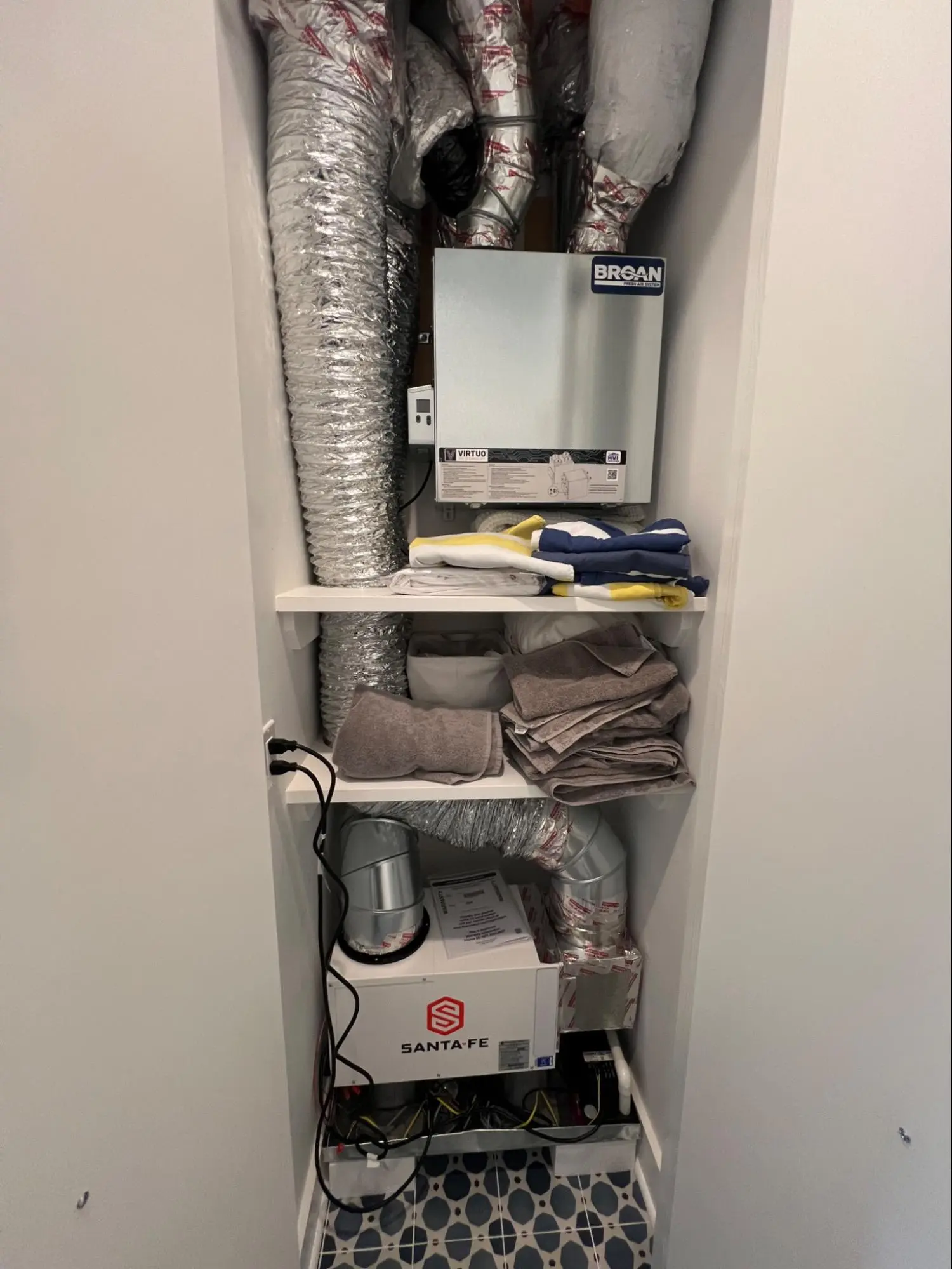
One of the most challenging parts of this project involved the upstairs dehumidifier.
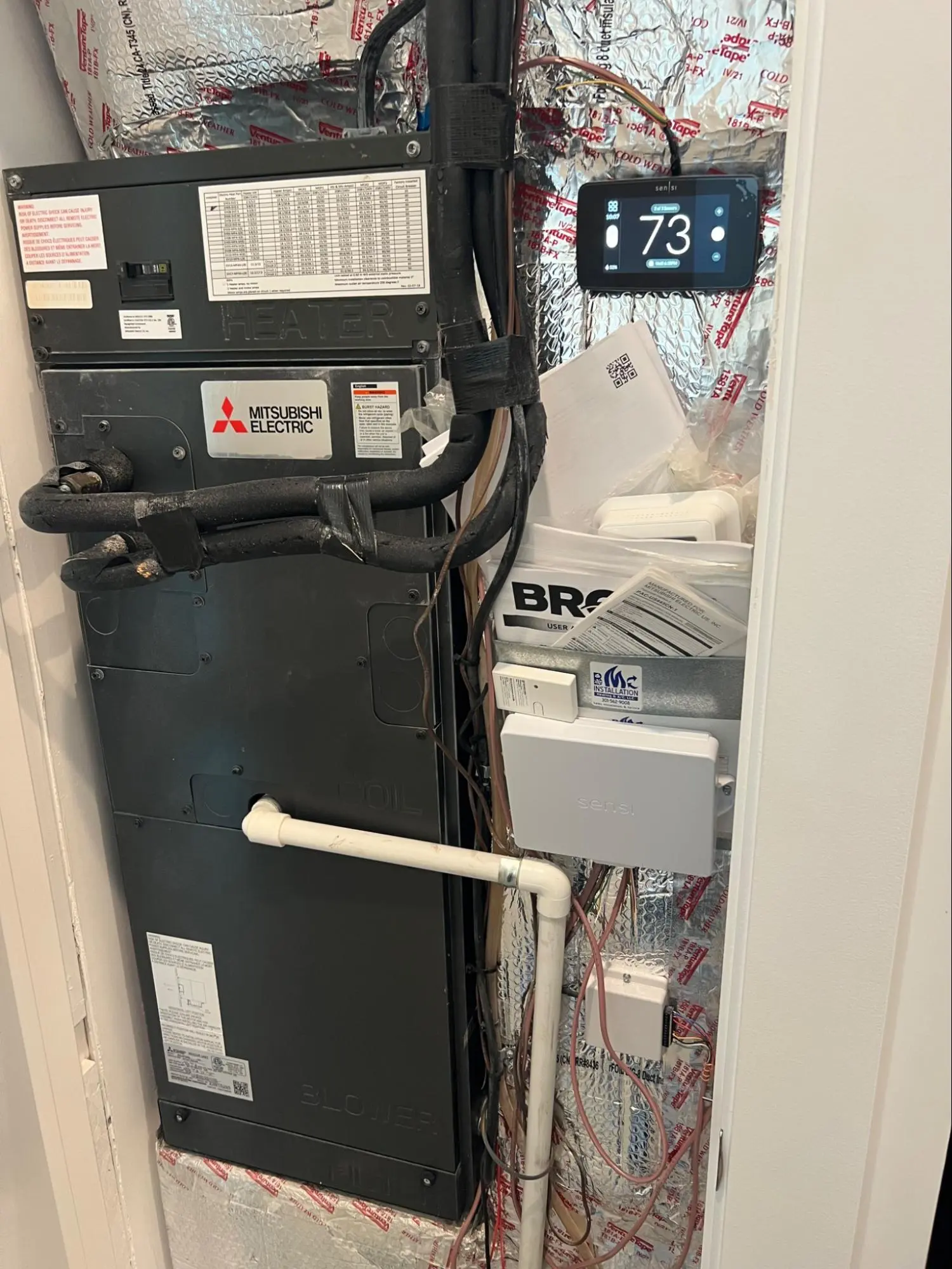
The mechanical space surrounding the upstairs Mitsubishi system was extremely tight.
There was limited room for the additional dehumidifier, duct transitions, and connections to the existing HVAC ductwork.
A standard installation arrangement would not fit properly.
Instead of compromising the layout, our technicians developed a custom ductwork solution to accommodate the equipment.
This required careful planning and fabrication to make the dehumidifier fit within the available mechanical space while maintaining an appropriate airflow path.
The upstairs installation became a key part of the project because it demonstrated the importance of custom ductwork design in homes with limited mechanical space.
Our Solution: Two Whole-Home Dehumidifiers with Integrated Controls
1. Installing the Upstairs Dehumidifier
We installed the first whole-home dehumidifier to serve the upstairs Mitsubishi Electric system.
Because of the limited mechanical space, the installation required customized duct connections.
Our technicians measured the available space and modified the ductwork layout to accommodate the new equipment.
The goal was to create a compact, functional installation without unnecessarily occupying additional space.
The dehumidifier was connected to the existing air distribution system using a return-to-supply configuration.
This arrangement allows air to be drawn from the return side, pass through the dehumidifier, and be discharged into the supply ductwork.
2. Customizing the Upstairs Ductwork
The upstairs ductwork required additional attention because of the physical constraints around the equipment.
We customized the duct transitions and connections to fit the dehumidifier into the available area.
This included adapting the ductwork to the equipment location rather than relying on a standard connection layout.
The customized arrangement allowed the dehumidifier to fit neatly within the tight mechanical space while providing the required duct connections.
This was not simply an equipment installation. It was also a custom ductwork project designed around the home’s existing mechanical layout.
3. Installing the Downstairs Dehumidifier
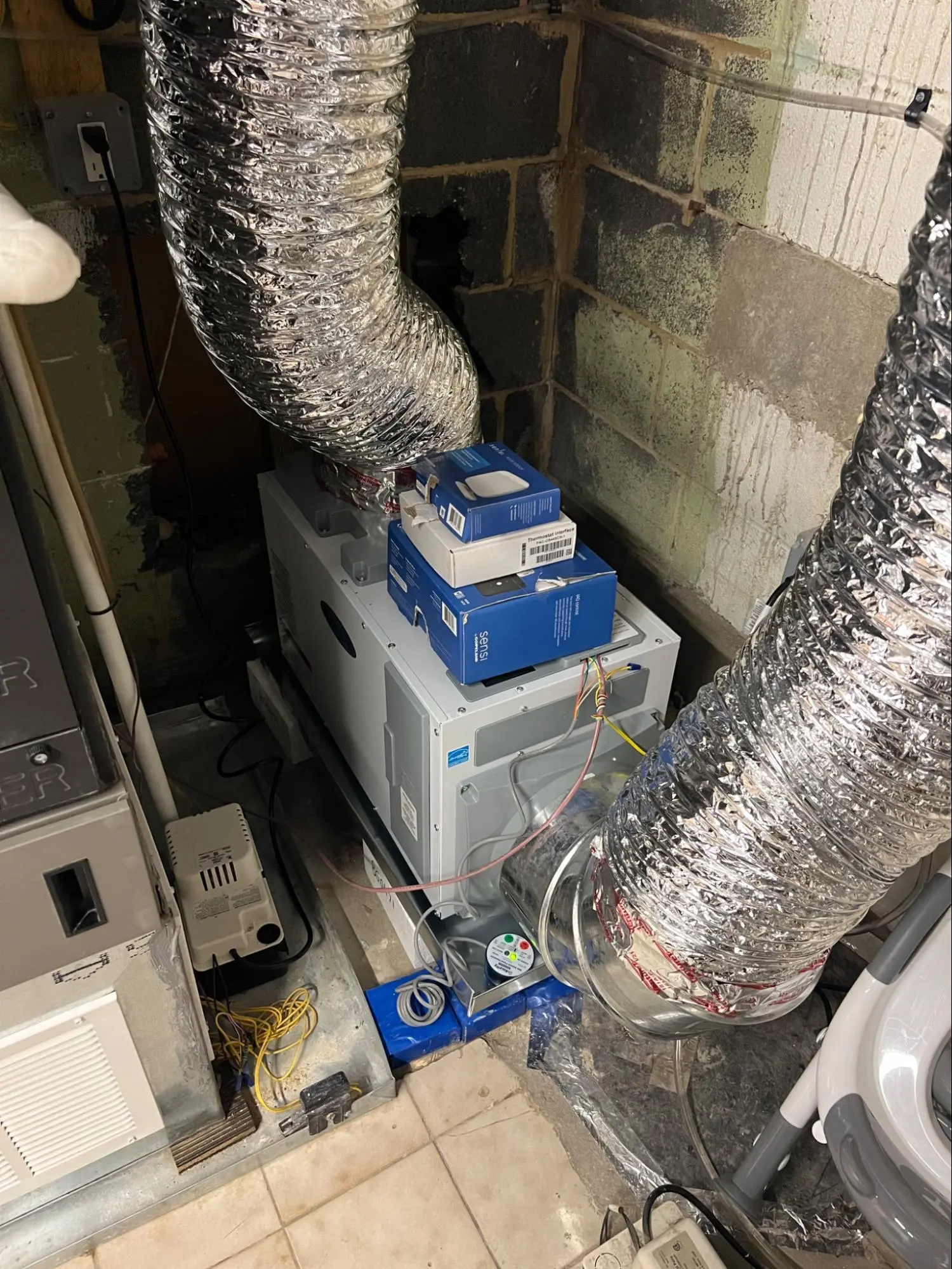
The second whole-home dehumidifier was installed to serve the downstairs Mitsubishi Electric system.
Like the upstairs installation, the downstairs dehumidifier was connected using a return-to-supply ductwork configuration.
This provided a dedicated source of moisture removal for the downstairs area.
With separate dehumidifiers serving each HVAC system, the home gained a more tailored approach to humidity management.
4. Integrating the Existing Mitsubishi Electric M-Series Systems
The home already had two Mitsubishi Electric M-Series heating and cooling systems.
Rather than replacing this equipment, we designed the dehumidification installation around the existing systems.
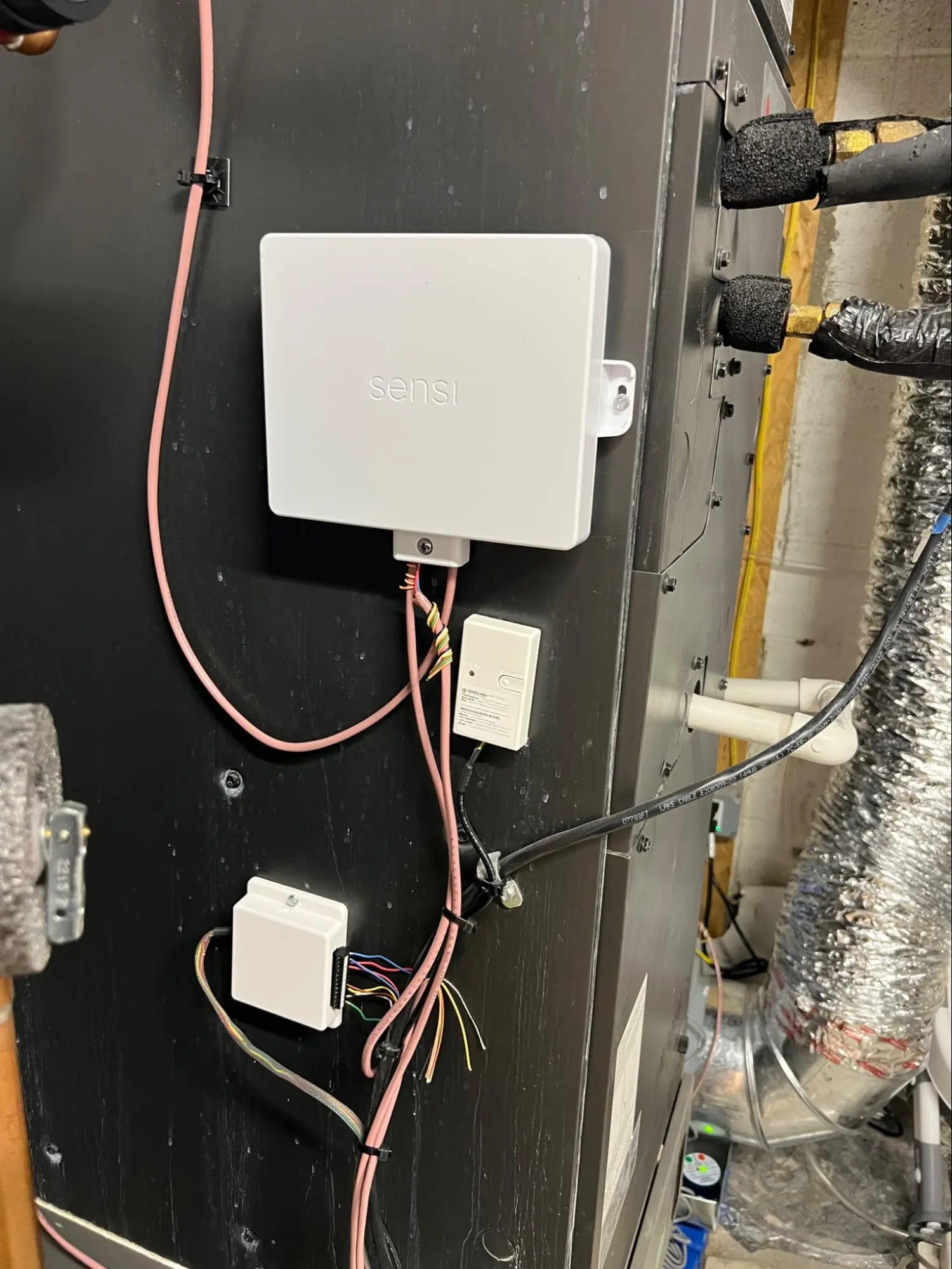
Mitsubishi Electric equipment uses specialized communication and control methods that differ from those of many conventional 24-volt HVAC systems.
To integrate the controls, we used compatible Mitsubishi third-party control interfaces.
These interfaces allowed the existing Mitsubishi equipment to work with the selected conventional thermostat configuration.
This was an important part of the installation because it allowed us to expand the home’s comfort-control capabilities without replacing the existing heating and cooling systems.
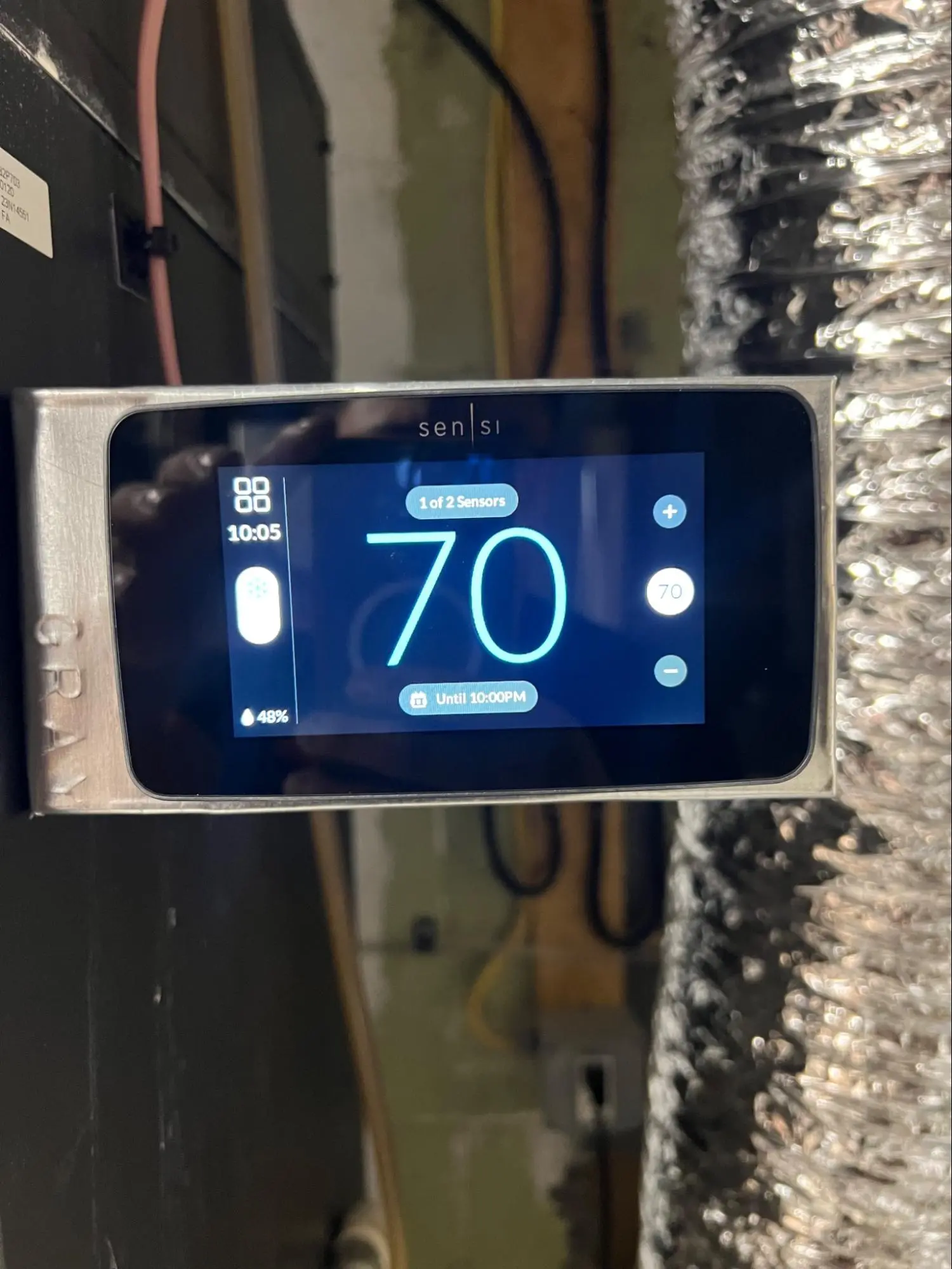
5. Configuring the Sensi Touch 2 Thermostats
We configured the Sensi Touch 2 thermostats to coordinate the Mitsubishi heating and cooling systems with the new dehumidifiers.
The goal was to provide a convenient control arrangement for both temperature and humidity.
Rather than requiring separate controls for the Mitsubishi equipment and the dehumidifiers, the homeowner could manage these functions through the corresponding Sensi thermostat interface.
Each upstairs and downstairs system was configured to serve its respective area.
This provided a more streamlined approach to operating the home’s heating, cooling, and humidity-control equipment.
6. Connecting the Dehumidifiers from Return to Supply
Both dehumidifiers were installed using return-to-supply duct connections.
With this configuration, air enters the dehumidifier from the return-air side and is discharged into the supply-air system after moisture removal.
The conditioned air can then be distributed through the home’s existing ductwork.
Proper return-to-supply installation requires attention to airflow, duct pressure, equipment specifications, and control sequencing.
For this project, the ductwork configuration was adapted to the existing Mitsubishi systems and the available installation space.
The Results: Indoor Humidity Reduced to Approximately 50%
Following the installation, the home’s indoor relative humidity decreased to approximately 50%.
This was a significant outcome because the homeowner’s primary concern was excessive indoor moisture.
The new dehumidifiers provided dedicated humidity control for the upstairs and downstairs areas.
The integrated controls also made it easier to manage heating, cooling, and dehumidification from the corresponding thermostat interfaces.
Project highlights included:
- Evaluated excessive indoor humidity in a high-performance home.
- Worked with two existing Mitsubishi Electric M-Series systems.
- Installed one whole-home dehumidifier for the upstairs HVAC system.
- Installed a second whole-home dehumidifier for the downstairs HVAC system.
- Overcame limited mechanical space around the upstairs equipment.
- Customized the upstairs ductwork to accommodate the dehumidifier.
- Connected both dehumidifiers using return-to-supply ductwork configurations.
- Installed Mitsubishi-compatible third-party control interfaces.
- Configured Sensi Touch 2 thermostats for integrated heating, cooling, and dehumidification control.
- Reduced indoor relative humidity to approximately 50%.
- Improved the homeowner’s ability to manage moisture levels independently of normal cooling demand.
Why High-Performance Homes May Need Dedicated Dehumidification
A common misconception is that a high-efficiency air conditioning system will automatically maintain ideal humidity levels.
However, temperature control and humidity control are not the same.
Air conditioners remove moisture while cooling, but they generally operate based on indoor temperature.
In a well-insulated and tightly sealed home, the cooling system may satisfy the thermostat before enough moisture has been removed.
This can result in comfortable temperatures but elevated indoor humidity.
Dedicated whole-home dehumidifiers address this problem by responding to moisture levels rather than relying exclusively on cooling demand.
For homeowners with high-performance properties, this can be an important part of maintaining comfortable and stable indoor conditions.
Why Proper Controls and Custom Ductwork Matter
This project demonstrates two important aspects of specialized HVAC work.
Control Integration
The existing Mitsubishi Electric systems required compatible third-party interfaces to work with the Sensi Touch 2 thermostat configuration.
Proper integration allowed the new dehumidifiers and existing heating and cooling equipment to operate through a coordinated control arrangement.
Custom Ductwork
The upstairs mechanical space was too tight for a conventional installation layout.
By customizing the duct connections, Capital Heat Pumps was able to accommodate the dehumidifier without replacing or relocating the existing Mitsubishi system.
Together, these solutions allowed us to address the homeowner’s humidity concerns while working within the home’s existing mechanical infrastructure.
Need a Whole-Home Dehumidifier in Bethesda, MD?
At Capital Heat Pumps, we specialize in whole-home dehumidification, Mitsubishi Electric heating and cooling systems, thermostat integration, custom ductwork fabrication, and indoor air quality solutions.
Whether your home has excessive humidity, limited mechanical space, or an existing HVAC system that needs additional moisture-control equipment, our team can help design a practical solution.
We proudly serve Bethesda, Montgomery County, Washington, DC, and the surrounding DC Metro area.
Contact Capital Heat Pumps today to schedule a humidity-control evaluation or request an estimate for a whole-home dehumidifier installation in Bethesda, Maryland.
Capital Heat Pumps — Specialized Humidity Control, Custom Ductwork, and Integrated HVAC Solutions.
