
Accokeek, MD Dehumidifier Services
Sticky indoor air, damp basements, and fogged windows all point to excess humidity. Call Capital Heat Pumps at (301) 795-8896 for honest testing and upfront pricing across Accokeek, MD, Oxon Hill, Bowie, Upper Marlboro, and surrounding areas.
Air conditioners pull moisture from the air while they cool, but only when they run long enough. On mild summer days, your system reaches the set temperature quickly and shuts down before the cooling coil has enough time to wring water out of the air. That leaves your living spaces feeling cool and clammy at the same time, with indoor humidity often hovering near 70%. Dropping the thermostat a few extra degrees doesn’t solve the underlying dampness; it only makes the house uncomfortably cold and drives up your monthly electric bills.
Houses along Accokeek Creek and low-lying ground near Livingston Road constantly run into this moisture problem, especially in finished basements, split-level lower floors, and crawl spaces where ground dampness seeps in. A dedicated whole-home dehumidifier solves this mismatch by pulling water out of the air on its own schedule, operating completely independent of your cooling cycles. By managing moisture as a separate job, it keeps your rooms comfortably dry, protects your wood floors and drywall from mold, and lets you maintain a steady, energy-efficient temperature all summer long.
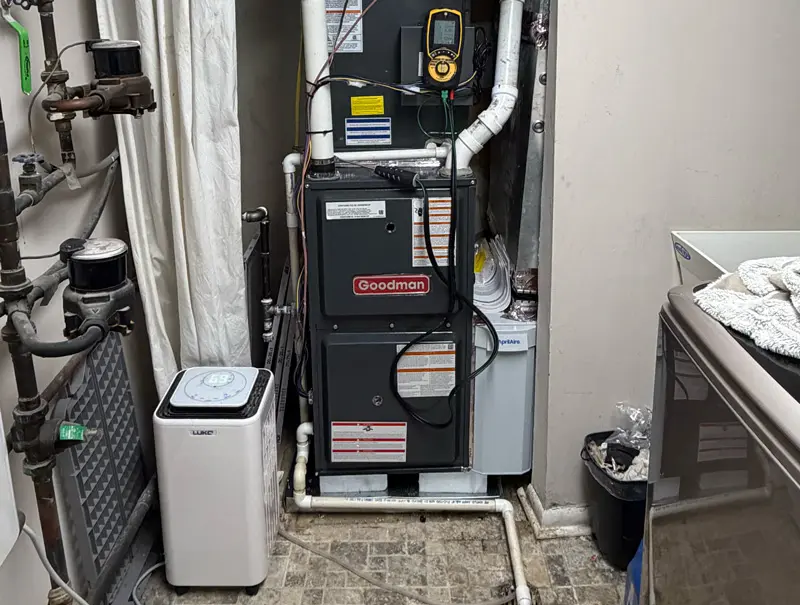
Always ask for a humidity check before buying moisture-control equipment. We measure your indoor air with digital meters first, so you get the right fix. Visit our indoor air quality page to learn more about keeping your indoor air balanced.
Whole Home Dehumidifiers for Accokeek, MD Homes
A central whole-house dehumidifier is an independent, dedicated appliance engineered with its own refrigeration system, motorized blower fan, and high-capacity air filter. Instead of relying on your main cooling equipment to handle moisture as a secondary task, a whole-home dehumidifier pulls damp air across an internal cold evaporator coil, condenses the airborne water vapor into liquid droplets, routes that water down a permanent drain line, and pushes dry air back into your living spaces:
- Independent wall control: The system operates from a dedicated wall-mounted humidistat or integrated smart thermostat that monitors relative humidity levels 24 hours a day, turning the equipment on whenever moisture climbs above your set target, even when your air conditioner is completely off.
- High-capacity removal performance: Residential whole-home systems are rated by how many pints of water they extract from the air every 24 hours, typically removing between 70 and 130 pints daily, which easily outperforms small plug-in portable models.
- Integrated filtration: Incoming indoor air passes through a pleated MERV-rated filter before hitting the cold coils, capturing household dust, pet hair, and airborne pollen. As a result, the machine cleans your air while drying it.
- Hands-free continuous drainage: Every unit is permanently tied into your home plumbing, a utility sink, a sump pit, or a dedicated outside PVC line, eliminating the daily chore of carrying heavy plastic buckets through your house.
- Out-of-sight mechanical operation: The equipment is installed directly in your basement, crawl space, mechanical closet, or attic, keeping equipment noise, vibrating compressors, and motor heat completely out of your primary bedrooms and living rooms.
Getting the equipment capacity right makes all the difference between a dry house and wasted energy. A dehumidifier that is sized too small will run nonstop through July and August without ever satisfying your wall control, while an oversized unit turns on and off too quickly, creating noisy air surges and leaving distant bedrooms feeling sticky. Our technicians calculate your home’s conditioned cubic footage, inspect air-leakage paths between floors, and check ground-level moisture penetration to install a system precisely matched to your layout.
By treating air distribution and moisture extraction as an engineered system, your home stays consistently fresh and dry without unnecessary air-handler cycling.
Summer Humidity in Prince George’s County and Why It Matters
Weather along the tidal Potomac basin creates a severe moisture challenge throughout late spring, summer, and early autumn. Humid air masses move up the river corridor and settle over Prince George’s and Charles counties, creating sustained outdoor dew points that regularly exceed 70 degrees. This heavy outdoor moisture presses against your home from all sides, entering through crawl space vents, basement slab seams, rim joists, exterior door seals, and unsealed ductwork runs located in unconditioned spaces:
- True comfort at higher thermostat settings: Dry indoor air allows your skin to cool itself through natural evaporation. A home kept at 75 degrees with 48% relative humidity feels significantly cooler, fresher, and more comfortable than a damp room set to 70 degrees with 68% humidity.
- Elimination of the thermostat spiral: Many homeowners respond to sticky, clammy rooms by continually dropping their thermostat setpoint, forcing their heat pump to run freezing cooling cycles that spike monthly utility bills without ever pulling enough moisture from the air.
- Prevention of equipment short-cycling: High-efficiency modern heat pumps often cool down indoor air temperatures very quickly during mild or overcast days, shutting off long before the indoor evaporator coil gets cold enough to pull water out of circulation.
- Protection for woodwork and structural framing: Excessive indoor humidity causes real physical damage to building materials, causing solid hardwood flooring to cup and buckle, wooden interior doors to swell and stick in their frames, trim joints to separate, and metal tools to rust in basements.
- Elimination of musty odors: That sour, damp smell common in lower levels and ground-floor rooms is caused by active mold and mildew colonies growing on moist drywall, carpets, and wood framing, which cannot be cured by simply changing an air filter.
Treating humidity as its own distinct load protects your equipment and your household budget. When your air conditioner no longer has to do double duty as an improvised dehumidifier, it operates within its intended mechanical range, lasts longer, and consumes far less electricity across the cooling season.
Taking control of your indoor moisture levels breaks the cycle of cold, damp rooms, protects your home’s structure, and delivers steady, predictable comfort through the most humid months of the year.
Ducted Dehumidifiers vs Portable Units
Many homeowners initially attempt to manage indoor dampness by purchasing small, portable dehumidifiers from local big-box hardware stores. While a portable plug-in appliance can help dry out a small laundry closet, a work shed, or a localized water spill, it is completely inadequate for managing whole-house moisture levels across multiple rooms:
- Whole-house duct coverage vs single-room drying: A portable floor unit only draws air from the immediate few feet surrounding its plastic casing, leaving nearby hallways and upper floors just as humid as before. A ducted central system ties right into your main supply and return trunks, using your central fan to distribute dry air evenly into every bedroom and living space.
- Automatic drainage vs overflowing water buckets: Portable dehumidifiers rely on small internal plastic tanks that hold only two or three gallons of water. In our humid climate, these buckets fill in four to six hours, triggering an internal float switch that shuts the unit down until someone carries the heavy container across the house to empty it. A central system constantly drains water through sealed plumbing.
- Quiet operation vs living-space motor noise: Portable units dump continuous compressor hum, fan vibration, and noticeable hot exhaust air directly into the room where you are trying to sleep, relax, or work. Central systems remain tucked away in basements, attics, or crawl spaces, running silently behind closed utility doors.
- Accurate central control vs localized cycling: Portable models measure humidity right next to their own cold, damp condenser coils, causing them to turn off prematurely before the actual living space has dried out. Central units read whole-house conditions from a calibrated wall humidistat mounted in a central living area.
- Long-term electrical efficiency: Small portable dehumidifiers utilize small, inexpensive rotary compressors that draw heavy electric current relative to the small amount of water they remove. Professional whole-home systems feature high-efficiency blowers and larger heat exchangers that extract twice as much water per kilowatt-hour of electricity consumed.
Investing in a permanent whole-home system eliminates the hassle of carrying water tanks, removes loud compressor noise from your daily life, and provides consistent humidity control across your entire property.
Basement and Crawl Space Units
Finished basements, daylight basements, and encapsulated crawl spaces in Southern Maryland absorb more ambient ground moisture than any other part of the house. Soil surrounding foundation walls stays cool and damp, allowing moisture vapor to migrate through porous concrete block, mortar seams, and concrete floor slabs. Installing a dedicated dehumidifier directly on the lower level intercepts this moisture at its primary entry point, preventing damp, stale basement air from rising upward into your first- and second-floor bedrooms through the natural stack effect.
Where an existing heat pump system already serves the lower level, our technicians can tie the dehumidifier directly into the basement duct trunk or install dedicated supply drops to circulate dry air throughout the finished rooms. For closed, encapsulated crawl spaces, the unit mounts on heavy-duty vibration-absorbing hanging straps or a raised concrete pad, running quietly beneath your floors to maintain a dry, clean subfloor environment that protects wood joists, wiring, and duct insulation from rot and moisture degradation.
Managing moisture at the foundation level stops odors before they circulate, keeps subflooring solid, and creates a clean, usable space for storage or finished living.
Installation and Drainage Options
A successful whole-home dehumidifier installation requires two essential mechanical decisions: how the dried air will circulate through your living spaces, and how the collected water will drain away permanently. Proper planning prevents water leaks, eliminates whistling duct noise, and ensures balanced airflow:
- Tied into the central return trunk: The dehumidifier draws return air from your central grilles, extracts excess moisture, and feeds the dry air back into your heating and cooling system supply ductwork, using your main air handler fan to circulate dry air evenly through all living areas.
- Dedicated supply and return duct runs: In homes with finished basements, split-level additions, or multi-story layouts where certain rooms hold more moisture than others, we run dedicated sheet metal or insulated flexible ducts to pull air directly from the dampest rooms and discharge dry air right where it is needed most.
- Standalone circulation for encapsulated spaces: When installed inside a sealed crawl space or unfinished utility basement, the equipment sits on a level support pad or suspension rack, pulling damp air from one side of the foundation and blowing warm, dry air across the opposite wall to circulate air through the entire footprint.
- Gravity condensate drainage: Whenever feasible, we route a rigid PVC drain line pitched downward at a steady slope toward a nearby floor drain, sump pump basin, or through an exterior band joist to a safe outdoor discharge location, allowing water to drain away naturally by gravity without mechanical parts.
- Automatic condensate removal pumps: In homes where the air handler or dehumidifier sits below grade without an accessible floor drain, we install a heavy-duty condensate pump equipped with an internal float switch and a secondary safety shut-off wire that instantly powers down the dehumidifier if the drain line ever backs up.
- Integrated electrical controls: We wire the dehumidifier controls to integrate directly with your central system blower relay, ensuring that the central fan operates at low speed whenever the dehumidifier calls for drying, distributing conditioned air smoothly throughout the house.
Every installation our trusted technicians complete includes testing static air pressure, sealing duct joints with mastic to prevent air leakage, and mounting wall controls in open, representative hallways away from direct sunlight, drafty windows, and supply registers.
Taking the time to install dedicated drainage and balanced duct transitions ensures your dehumidifier runs quietly, drains reliably, and requires no daily monitoring.
Never buy equipment for a problem that a simple drain repair or ground cover can fix. We always point out the simplest fix first. When uneven temperatures between floors are your main issue, visit our zoning page to see how airflow dampers balance your home.
Protecting Your Home From Mold and Moisture in Southern Maryland
Mold spores don’t need a major plumbing burst or roof leak to multiply rapidly inside a house; they only need elevated surface moisture and ambient relative humidity sustained above 60%. Cool basement drywall, uninsulated cold water pipes, subfloor sheathing beneath carpeting, and the back corners of closets against exterior walls are prime spots for mold colonization during Maryland’s humid summers. High humidity also creates an ideal breeding ground for microscopic dust mites, which thrive in damp bedding, upholstered furniture, and carpets and can cause severe seasonal allergy and asthma flare-ups that homeowners often mistake for outdoor pollen reactions.
Maintaining indoor summer humidity consistently between 45% and 55% removes the moisture that mold, mildew, and dust mites need to survive. Our BPI-certified approach views your home as an interconnected building system, addressing moisture sources from the soil up to the roof:
- Sealing dirt crawl spaces with heavy ground vapor barriers: We inspect crawl space floors to ensure durable, puncture-resistant polyethylene vapor barriers cover all exposed earth, preventing soil moisture from evaporating upward into floor joists and living spaces.
- Insulating chilled water lines: Wrapping cold domestic water pipes with closed-cell foam insulation stops condensation from beading up on metal surfaces and dripping onto basement drywall or subfloors.
- Checking gutter discharge and perimeter grading: Directing rainwater at least six feet away from your foundation through downspout extensions prevents rain from saturating the soil against basement foundation walls.
- Sealing duct joints in unconditioned spaces: Leaky return ducts running through damp basements or crawl spaces draw humid, unfiltered air into your central heating and cooling equipment. Learn more about sealing duct joints on our ductwork page.
- Performing seasonal system tune-ups: Annual preventative maintenance ensures that condensate drain lines remain completely clear of algae and sediment, internal cooling coils stay clean, and air filters are replaced before airflow is choked.
Combining whole-home dehumidification with comprehensive moisture management protects your indoor air quality, preserves your home’s structural framing, and prevents expensive mold remediation repairs down the road.
Capital Heat Pumps is locally owned and operated in Accokeek, MD, and is fully licensed and insured across Maryland, Washington, DC, and Virginia. We deliver quality workmanship backed by clear communication, no pressure, and our satisfaction guarantee.
Frequently Asked Questions
Ready to get rid of sticky indoor air? Call Capital Heat Pumps at (301) 795-8896 to set up an in-home moisture check and get straightforward, upfront pricing in Accokeek, MD, and nearby Prince George's County communities.
